Quick answer: what to check before you go
Each palace sets its own hours and closed day, and winter hours apply only for a set date range. Check the official site for the current season on the morning you go. Use royal.khs.go.kr for the four Heritage Service palaces and museum.seoul.go.kr for Gyeonghuigung.
The most important rule is that Gyeongbokgung closes on Tuesdays, while the other four close on Mondays. A Wednesday-to-Sunday visit is the only way to see all five in one day.
Fees may change in 2027. The Korea Heritage Service has signalled new admission fee guidelines. I could not confirm the 2027 fees or the date they take effect. Treat every price below as the current published figure, which may not apply to the later part of your winter trip. Free entry for hanbok wearers was also under public discussion, so confirm it before you rent.
This guide covers Seoul's five Joseon-era palaces:
- Gyeongbokgung, the main royal palace
- Changdeokgung, including the Huwon (Secret Garden)
- Changgyeonggung
- Deoksugung
- Gyeonghuigung
Four of these are managed by the Korea Heritage Service, which was named the Cultural Heritage Administration until it was renamed on 17 May 2024. Gyeonghuigung is run separately through the Seoul Museum of History.
The figures below come from the Heritage Service's palace pages, the Seoul Museum of History and secondary guides. They are the current published schedules, not confirmed 2026-2027 notices. Re-check them close to your travel date.
Palaces can also close early or shut sections for maintenance, filming or state events. These closures are announced on each palace's official website and social channels, sometimes only a few days ahead. I found no confirmed maintenance closures for winter 2026-2027, but that does not mean none are planned.
Palace-by-palace table
All prices are in Korean won (KRW) for adults, as currently published. Hours are the published winter figures (roughly November to February) and are not confirmed for 2026-2027. Spring, summer and autumn hours are longer.
| Palace | Winter hours (unconfirmed for 2026-27) | Last admission | Weekly closed day | Adult ticket | Hanbok entry | Notes | Source |
|---|---|---|---|---|---|---|---|
| Gyeongbokgung | Published as 09:00–17:00 (Nov–Feb); confirm | Published as 16:00; confirm | Tuesday | ₩3,000 | Free (current rule) | Gwanghwamun Royal Guard ceremony runs separately (see route section) | royal.khs.go.kr (Heritage Service palace pages) |
| Changdeokgung | Published as about 09:00–17:30 in winter; confirm, including the end date of the season | About one hour before closing | Monday | ₩3,000 | Free for the main palace (current rule); check Huwon separately | Huwon needs a separate ticket and guided tour: ₩5,000 extra, timed sessions, capped group size | royal.khs.go.kr |
| Changgyeonggung | Published as 09:00–21:00; confirm the winter closing time | Published as 20:00; confirm | Monday | ₩1,000 | Free (current rule) | Separate ticket from Changdeokgung. The two palaces have a connecting gate; I could not confirm it is open in winter | royal.khs.go.kr |
| Deoksugung | Published as 09:00–21:00; confirm | Published as 20:00; confirm | Monday | ₩1,000 | Free (current rule) | Published evening hours (confirm for winter); the museum inside has its own ticket | royal.khs.go.kr |
| Gyeonghuigung | Published as 09:00–18:00; confirm | Not confirmed | Monday (check holiday closures) | Free | Not applicable (already free) | Usually the least crowded of the five | museum.seoul.go.kr |
Other points to check for 2026-2027:
- Combined ticket. An integrated palace ticket costs about ₩10,000 for adults and is valid for 3 months from first use. It covers Gyeongbokgung, Changdeokgung (including Huwon), Changgyeonggung, Deoksugung and Jongmyo Shrine.
- It pays off if you do Huwon plus Gyeongbokgung and Changdeokgung (₩11,000 separately), or all four paid palaces.
- It does not pay off for Changdeokgung, Huwon and Changgyeonggung alone, which come to only ₩9,000.
- Check whether the price changes in 2027.
- Public holidays. The Heritage Service's Deoksugung page says that if a public or substitute holiday falls on the closed day, the palace opens and closes the following day instead. Check the other palaces' notices for each holiday.
- Seollal (Lunar New Year). Seollal usually falls in late January or February. Check the official 2027 holiday dates, and check each palace's notices for any free-entry or special-programme arrangements.
- Monthly free day. Palace entry has been free on the monthly Culture Day (the last Wednesday of the month). Confirm that this still applies.
- Concessions. The official English notice lists free entry for:
- children aged 6 and under
- seniors aged 65 and over (check whether this applies to foreign visitors)
- hanbok wearers
Young visitors aged 7–18 pay a reduced fee; for Changdeokgung that is listed at ₩1,500. Ask at the ticket office if you think you qualify. I did not verify group rates or concessions on English guided tours. - Night openings. Special night openings at Gyeongbokgung and Changgyeonggung have usually been spring and autumn events booked in advance. I found no winter 2026-2027 night programme. They are separate from Deoksugung's regular evening hours.
How the five palaces differ
If you only have time for two or three, this section will help you choose.
Gyeongbokgung
Gyeongbokgung was founded in 1395 as the main royal palace of the Joseon dynasty. It is the largest and busiest of the five.
Come here for:
- Geunjeongjeon, the throne hall
- Gyeonghoeru Pavilion, which stands on a pond
- The Royal Guard changing ceremony at Gwanghwamun gate
Two museums sit inside or beside the grounds: the National Palace Museum of Korea and the National Folk Museum of Korea. Both have been free to enter in the past, but I could not confirm this for 2026-2027, so check before you go. They are useful on a cold day.
Changdeokgung
Changdeokgung was built in 1405. It was listed as a UNESCO World Heritage Site in 1997. The buildings follow the hillside rather than a strict grid, which makes the layout feel more natural than Gyeongbokgung's.
The main reason to plan ahead is Huwon, the rear garden of pavilions and ponds. You can only visit it on a timed, guided tour with capped group sizes. Check the official site for winter tour times and English-language tours; I could not confirm them for 2026-2027.
Changgyeonggung
Changgyeonggung sits directly next to Changdeokgung and feels more relaxed. During the Japanese colonial period it was turned into a zoo and botanical garden. The zoo was later moved out and the palace restored.
The white glasshouse, Daeonsil, survives from that era. I could not confirm its winter opening or build date, so check that it is open when you visit. If the palace's published late closing time holds in winter, it makes a good last stop.
Deoksugung
Deoksugung is in central Seoul, next to City Hall. It is known for two things:
- Western-style buildings, such as Seokjojeon, standing next to traditional halls
- The stone-wall walk (Deoksugung Doldam-gil), which runs along its walls into Jeongdong
It is compact and flat, and its published hours run into the evening (confirm the winter closing time). It is the easiest palace to fit in around shopping or dinner.
Gyeonghuigung
Gyeonghuigung is the smallest and quietest of the five. Its construction began in 1617 and was completed in 1623, and much of it was dismantled in the 20th century.
It sits on Saemunan-ro, beside the Seoul Museum of History, between Gwanghwamun and Seodaemun stations. Allow 30 to 45 minutes.
Hanbok free entry: current rules
The rule: the Heritage Service's palace pages currently give free entry to visitors wearing hanbok (traditional Korean clothing) at Gyeongbokgung, Changdeokgung, Changgyeonggung and Deoksugung. Gyeonghuigung is already free, so the rule makes no difference there.
The Heritage Service has said new fee guidelines are coming, and a discount in place of free entry has been suggested in public discussion. I could not confirm whether free hanbok entry will continue, or whether it covers Huwon. Re-check this rule, especially for February 2027.
The official palace sites are the final authority on who qualifies. Do not assume that a rule for one palace, or for Huwon, applies to all five.
What counts as hanbok: the official guidance says a partial outfit does not qualify. A hanbok jacket (jeogori) with jeans, or a skirt or trousers with a T-shirt, will not get free entry. Wear a full outfit.
How eligibility is checked: staff at the ticket gate make the call. If you arrive in ordinary clothes, you simply buy a ticket. I could not find published guidance on whether a rental receipt is needed, so ask your rental shop.
Winter practicalities:
- Warmth. Rental hanbok are usually lightweight, so plan to layer thermal clothing underneath. Many rental shops near Gyeongbokgung offer outerwear; ask what is included when you book.
- Crowds. Weekends and Seollal week bring large hanbok-wearing crowds to Gyeongbokgung, especially around Gyeonghoeru and the throne hall. Arriving at opening time helps.
- Rental hours. Rentals are usually charged by the hour. A five-palace day in hanbok is long and cold, so many people wear it for one palace only.
One-day route that avoids backtracking
The palaces line up roughly from west to east across central Seoul. Visiting them in that order means you never retrace your steps.
Choose a Wednesday to Sunday. Mondays close four palaces, and Tuesdays close Gyeongbokgung.
Suggested order
All times below are rough estimates. Check them against current hours and a transit app such as Naver Map or KakaoMap on the day. I did not verify walking times or station exits.
| Time (estimate) | Stop | Getting there (verify on a transit app) |
|---|---|---|
| 09:00–09:45 | Gyeonghuigung | Seodaemun Station or Gwanghwamun Station (both Line 5); check the exits on your map app |
| 09:45–10:00 | Walk to Deoksugung | Roughly 15 minutes on foot; check on your map app |
| 10:00–11:15 | Deoksugung | Deoksugung has held a guard ceremony at Daehanmun gate; I could not confirm the winter schedule, so check the days and times |
| 11:15–11:40 | Walk to Gyeongbokgung | Roughly 20–25 minutes up Sejong-daero; check on your map app |
| 11:40–14:30 | Lunch and Gyeongbokgung | I could not confirm the winter days and times of the Gwanghwamun changing ceremony, so check the schedule |
| 14:30–14:50 | Walk or ride to Changdeokgung | Roughly 20 minutes on foot along Yulgok-ro, or Anguk Station (Line 3) |
| 14:50–16:30 | Changdeokgung, plus Huwon if booked | Check the last admission time for the day |
| 16:30–18:00 | Changgyeonggung | Through the connecting gate if it is open (not confirmed for winter), otherwise via the street |
From Changgyeonggung, you can walk to Gwangjang Market in Jongno 5-ga for dinner, or to Hyehwa Station (Line 4).
Notes on the route
- This is ambitious in winter. Short daylight and an early last admission at Gyeongbokgung make five palaces in one day tight; the published winter last admission is 16:00, so confirm it. A realistic alternative is to do Gyeonghuigung, Deoksugung and Gyeongbokgung in one day, then treat Changdeokgung, Huwon and Changgyeonggung as a separate half-day.
- Huwon sets your schedule. Book the Huwon slot first through the official booking page, then fit the other palaces around it. Some reports say about half the places in each session are sold online and the rest on site, but I could not confirm the current split. If your slot is in the morning, start at Changdeokgung and run the route in reverse, from east to west.
- Evening variation. Deoksugung's published hours run to 21:00 (last admission 20:00); confirm these for winter before relying on this plan.
- Start at Gyeongbokgung at opening time and head east to Changdeokgung and Changgyeonggung.
- Take the subway back to City Hall Station for Deoksugung in the evening.
- This adds one subway ride back west, but you see Deoksugung after dark.
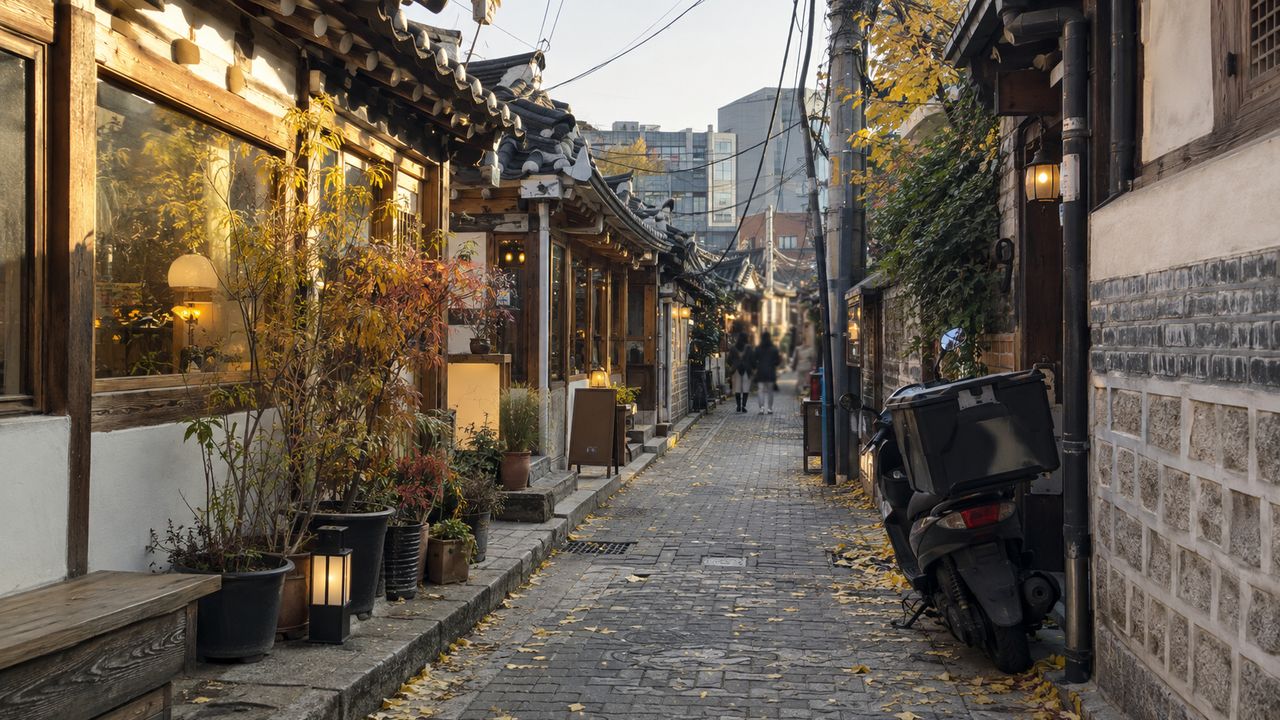
- Take care in Bukchon. The direct walk from Gyeongbokgung to Changdeokgung can pass through Bukchon Hanok Village, which is a residential neighbourhood where people live. Visiting restrictions and fines have been introduced for parts of it. I could not confirm the restricted hours or fine amounts, so check the current rules before you go. If you do walk through:
- keep your voice down
- do not photograph residents or into homes and courtyards
- avoid early mornings and evenings
Main roads such as Yulgok-ro avoid the residential lanes.
If it snows
Palace closure policies for snow were not confirmed. Heavy snow or ice may close sections, especially sloped paths and the Huwon tour route. The Gyeongbokgung ceremony schedule also notes that weather can affect performances.
On the morning of your visit, check the notice board on each palace's official website and its social media accounts. Closures are not always posted in English, so a browser translation tool helps.
Which palaces suit bad weather
- Mostly outdoor and exposed: Gyeongbokgung's large courtyards and Changdeokgung's Huwon. Huwon is hilly and the most likely to be icy.
- Easier in snow:
- Deoksugung is flat and compact.
- Gyeonghuigung is small and sits beside the Seoul Museum of History; check its admission and hours.
- Changgyeonggung has the Daeonsil glasshouse; check that it is open.
Plan B
Keep the route order the same and swap only the most outdoor-heavy stop:
- Replace a long Gyeongbokgung walk with the National Palace Museum next door (check that admission is still free).
- Replace Huwon with Tongin Market near Gyeongbokgung's west side, or Gwangjang Market near Changgyeonggung. Check what is covered or indoors at each before you rely on them in snow.
Snow on palace roofs is beautiful, so a light-snow morning is worth going out for if paths are open.
Footwear and timing
Wear shoes with grippy soles. Stone steps, raised thresholds and the granite paving in courtyards get slippery fast.
Allow 20 to 30 percent more time between stops, and take the subway between palaces rather than walking if pavements are icy.
Practical tips and booking
Tickets. Main palace tickets are sold at the gate on the day. Huwon needs its own timed ticket. Book it in advance online if you can, because winter sessions are limited. Some places have been sold on site, so check the current split.
Payment. I could not confirm which cards each ticket counter accepts, or whether prices include VAT. Carry a little cash as a backup, especially for small purchases near Gyeonghuigung.
Where to stay. For a palace-focused trip, staying around Jongno or City Hall puts you within walking distance of at least three palaces. You can compare options near Gwanghwamun and City Hall on
Guided visits. The palaces have offered free guided tours in English at set times, and these are often the best value. I could not confirm the 2026-2027 times, so check the schedule at each palace. If you prefer a private or small-group guide,
Data. You will rely on a transit app and on morning closure notices, so working mobile data matters. Setting up an eSIM before you land saves time at the airport;
Checklist for the night before
- [ ] Check current hours and last admission for each palace you plan to visit.
- [ ] Confirm the closed day: Monday for four palaces, Tuesday for Gyeongbokgung.
- [ ] Check whether fees or the hanbok entry rule have changed for 2027.
- [ ] Book Huwon if you want it, and build the day around your slot.
- [ ] Pick your route: west to east, or the evening Deoksugung variation.
- [ ] Check the weather and palace notices on the morning of your visit.
FAQ
Which Seoul palaces are closed on which day?
Gyeongbokgung closes on Tuesdays. Changdeokgung, Changgyeonggung, Deoksugung and Gyeonghuigung close on Mondays, according to the published schedules. If a public or substitute holiday falls on a closed day, check each palace's notice, since Deoksugung's page says it opens the following day instead. Wednesday to Sunday is the only way to see all five in one day.
Do I get free entry to Seoul palaces if I wear hanbok?
The Heritage Service's palace pages currently give free entry to visitors in a full hanbok outfit at Gyeongbokgung, Changdeokgung, Changgyeonggung and Deoksugung. A partial outfit does not qualify, and staff at the gate decide eligibility. New fee guidelines have been signalled, so confirm the rule before you rent.
Is the Huwon garden at Changdeokgung included in the regular ticket?
No. Huwon needs a separate ticket and a timed, guided tour with capped group sizes, listed at ₩5,000 extra. Book the slot in advance where possible, since winter sessions are limited.