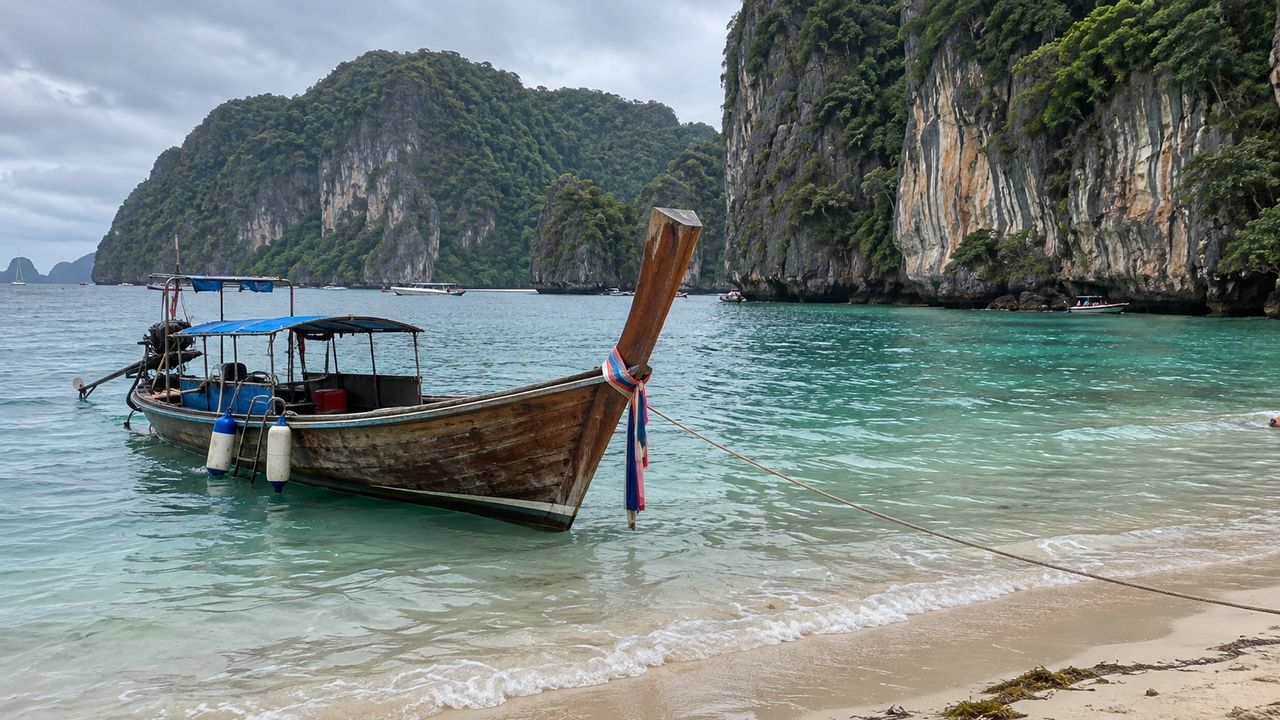
Short answer: For a 10-day trip in November or December, pair Bangkok and Chiang Mai with the Andaman coast (Krabi, Koh Lanta, Phuket, Phi Phi). The Gulf islands (Koh Samui, Koh Phangan, Koh Tao) usually get more rain and rougher seas until about late December. This guide gives two routes, one for each coast, plus a transfer table and the entry rules to confirm before you book. Fares, schedules and fees change, so check each one with the operator or official source before you book.
Quick answer: which coast to choose in November and December
| Andaman coast | Gulf of Thailand | |
|---|---|---|
| Main bases | Krabi (Ao Nang, Railay), Koh Lanta, Phuket, Phi Phi | Koh Samui, Koh Phangan, Koh Tao |
| Typical Nov–Dec conditions | Southwest monsoon ends around October; seas usually calmer by mid to late November | Northeast monsoon rain often peaks in the last months of the year, and November is frequently very wet |
| Ferry reliability | Generally good once boat season starts | Crossings can be rough, delayed or cancelled |
| Best for | Most travelers, especially beach and snorkel trips | Gulf-specific plans, Koh Tao diving if you accept more rain |
Choose the Andaman coast if you want the most dependable beach days in these two months.
Choose the Gulf only if you have a specific reason, such as a Koh Samui resort booking, a Koh Tao dive course, or travel in the last week of December when conditions often start to improve. If you choose the Gulf, build in a buffer day.
One caveat: monsoon timing shifts from year to year. Early November on the Andaman side can still bring showers, and some years the Gulf dries out earlier. These are general seasonal patterns, not current Thai Meteorological Department data. Check the TMD forecasts and marine warnings in the week before you travel. Don't treat seasonal patterns as a guarantee.
Route A: 10 days via Bangkok, Chiang Mai and the Andaman coast
| Days | Base | Focus |
|---|---|---|
| 1–3 | Bangkok | Arrival, Grand Palace and Wat Pho, one day trip |
| 4–5 | Chiang Mai | Old city temples, Doi Suthep, cooking class |
| 6–9 | Krabi (Ao Nang) or Koh Lanta | Beach time, Phi Phi or island-hopping day tours |
| 10 | Krabi or Phuket airport | Fly to Bangkok or home |
Days 1–3: Bangkok
- Day 1: Arrive at Suvarnabhumi (BKK) or Don Mueang (DMK). Keep the first evening light. A riverside or Sukhumvit base near BTS/MRT stations makes the next two days easier.
- Day 2: Visit the Grand Palace and Wat Pho in the morning, then cross the river by ferry to Wat Arun.
- Grand Palace and Wat Pho: opening hours and admission prices change, so check the current figures on the official sites or at the gate. Go early, since both are best visited in the morning.
- Dress code at both: shoulders and knees covered, and no see-through or very tight clothing. Expect this to be enforced at the gate.
- Arrive early to avoid heat and tour-group crowds. Ignore anyone outside claiming the palace is "closed today."
- Day 3: Choose one day trip:
- Ayutthaya for temple ruins, about 1.5–2 hours by train or minivan.
- Maeklong Railway Market combined with Damnoen Saduak Floating Market, usually done as a half-day or full-day tour.
Getting to Chiang Mai: flight or overnight train
| Option | Time cost | Best for |
|---|---|---|
| Flight (BKK/DMK–CNX, roughly 1h15 in the air) | About half a day including airport time | Saving time; frequent daily departures |
| Overnight sleeper train (Krung Thep Aphiwat–Chiang Mai, roughly 11–13 hours; approximate, so confirm the current timetable, classes and fares with the State Railway of Thailand) | Uses your Day 3 evening and arrives the next morning | Budget travelers, people who enjoy rail travel, saving a hotel night |
The train arrives in the morning, so you lose the evening of Day 3 and possibly part of Day 4 depending on the arrival time. Flying lets you keep the Day 3 day trip and still arrive in Chiang Mai by mid-afternoon. Sleeper berths can sell out on popular dates, so book through the State Railway of Thailand's official channels.
Days 4–5: Chiang Mai
- Day 4: Explore the old city temples, including Wat Phra Singh and Wat Chedi Luang. In the evening, visit the Night Bazaar. If you're there on a Sunday, the Sunday Walking Street is the better choice.
- Day 5: Pick one of these:
- Doi Suthep temple in the morning and a Thai cooking class in the afternoon.
- A full-day trip to Doi Inthanon.
- November note: The Yi Peng lantern festival and Loy Krathong usually fall around the November full moon. They follow the lunar calendar, so confirm the 2026 dates with the Tourism Authority of Thailand or local organizers before booking. Hotels fill up and prices rise around these dates.
Days 6–9: Andaman coast
- Day 6: Fly Chiang Mai to Krabi (KBV) or Phuket (HKT). Check current airline schedules, because direct flights on these routes may be limited and may not run daily. If there's no direct flight on your date, connect through Bangkok. Then pick a base:
- Ao Nang (Krabi): about 30–45 minutes from Krabi airport. This is the easiest base for day tours, and Railay is a short longtail ride away.
- Koh Lanta: roughly 2–3 hours from Krabi airport by minivan, including a short car-ferry crossing. It's quieter with longer beaches, but you lose more of the day getting there.
- Day 7: Beach day. From Ao Nang, go to Railay. On Koh Lanta, try Long Beach or Kantiang Bay.
- Day 8: Phi Phi day tour, which runs from Ao Nang, Lanta and Phuket. Maya Bay is inside a national park, so expect a separate park fee and possible seasonal closures or swimming restrictions. Confirm the current fee and rules with your tour operator or the national park authority.
- Day 9: Another island tour, or a slow day:
- From Ao Nang: Four Islands or Hong Islands.
- From Lanta: Koh Rok or Koh Haa snorkeling.
Book day tours with clear cancellation terms, since boats don't run in bad weather.
Day 10: Fly out
Fly from Krabi or Phuket to Bangkok, or directly home if your airline connects. If you're based on Koh Lanta, leave at least 3 hours for the road transfer to Krabi airport, plus check-in time.
Route B: 10 days via Bangkok, Chiang Mai and the Gulf islands
| Days | Base | Focus |
|---|---|---|
| 1–3 | Bangkok | Same as Route A |
| 4–5 | Chiang Mai | Same as Route A |
| 6 | Travel day | Fly to Koh Samui or Surat Thani |
| 7–8 | Koh Samui or Koh Phangan | Beaches, Ang Thong Marine Park, optional Koh Tao |
| 9 | Buffer / return toward airport | Ferry back, overnight near your departure airport |
| 10 | Samui or Bangkok | Fly out |
Day 6: Chiang Mai to the Gulf
You have two options:
- Fly to Koh Samui (USM). Samui airport is privately run, mainly by Bangkok Airways, and fares tend to be higher than to other southern airports. Check whether a direct flight from Chiang Mai is available on your date. Otherwise connect through Bangkok.
- Fly to Surat Thani (URT), then bus and ferry to Samui or Phangan. This is usually cheaper but adds around 4 hours or more. Direct flights from Chiang Mai may not be available, in which case you connect through Bangkok.
Days 7–8: Koh Samui or Koh Phangan
- Koh Samui: Easiest logistics, with the airport on the island. Chaweng and Lamai are busy; Bophut and the north coast are calmer.
- Koh Phangan: Quieter outside Full Moon Party dates. Confirm the December 2026 party date before booking. Haad Rin prices spike around the party.
- Koh Tao (optional): About 1.5–2 hours by high-speed ferry from Samui. Diving and snorkeling still run in November and December, but visibility and sea state can be unreliable at this time of year. If you're doing a multi-day dive course, give it extra days rather than squeezing it in.
- Ang Thong Marine Park day trips from Samui are often cancelled in rough seas. Book with free cancellation.
Days 9–10: Getting back safely
Ferry crossings from Surat Thani (Donsak) to Samui and Phangan, and between the islands, depend on the weather. Timetables also change by season, so confirm them directly with the ferry operators close to your travel date.
The safest plan is to spend night 9 on the island with your departure airport. That means Samui if you're flying out of USM, or the mainland if you're flying from Surat Thani. On Day 10 you then won't need a ferry before your flight.
Transfer costs and times
Transfers are the part most itineraries leave out, and between islands they're often the largest hidden cost and time loss of the trip. Durations below are rough estimates, not operator timetables. Check current fares and timetables with each operator before you book.
| Route segment | Mode | Typical duration | Fare |
|---|---|---|---|
| Suvarnabhumi → city (Phaya Thai) | Airport Rail Link | About 26 min | Check operator for current fares and hours |
| Suvarnabhumi → central Bangkok | Metered taxi | 30–60+ min (traffic) | Meter plus airport surcharge plus tolls |
| Bangkok → Chiang Mai | Flight | About 1h15 | Varies by airline |
| Bangkok → Chiang Mai | Overnight sleeper train | About 11–13 h | Check SRT for current classes and fares |
| Bangkok → Chiang Mai | VIP bus | About 9–10 h | Check operator |
| Chiang Mai → Krabi / Phuket | Flight | Roughly 2 h (check schedule) | Check direct availability and fare |
| Chiang Mai → Koh Samui | Flight | Roughly 2 h (check schedule) | Check direct availability and fare |
| Krabi airport → Koh Lanta | Minivan (incl. car ferry) | About 2–3 h | Check operator |
| Krabi (Ao Nang) / Phuket → Phi Phi | Ferry | About 1.5–2 h | Check operator |
| Krabi / Phuket → Phi Phi | Speedboat | About 45–60 min | Check operator |
| Surat Thani → Koh Samui | Bus + ferry (Donsak) | About 3.5–4.5 h | Check combined fare |
| Koh Samui → Koh Phangan | High-speed ferry | About 20–30 min | Check operator |
| Koh Samui → Koh Tao | High-speed ferry | About 1.5–2 h | Check operator |
Practical tips:
- Bundle where you can. Combined bus-and-ferry tickets (for example, Surat Thani airport to Samui) and airport-to-island minivan transfers usually beat assembling the legs yourself.
- Check for fees on top of the fare. These may include any pier or local environment fee on Phi Phi, national park fees on day tours, and checked-baggage fees on low-cost domestic flights.
- Never book a tight connection between a boat and a flight.
Entry rules and documents to confirm before booking
Thai entry rules have changed several times since 2024, and the rules for 2026 may differ from those described below. Confirm everything on official sites before you book, and again before you fly.
- Visa exemption:
- From July 2024, citizens of 93 countries and territories could enter visa-free for up to 60 days.
- Secondary, non-official reports say Thailand may shorten the stay to 30 days for many nationalities and cut the list of eligible countries. Treat these reports as unconfirmed until the Ministry of Foreign Affairs publishes details, and don't rely on them either way. Your permitted stay in November or December 2026 may be 30 or 60 days.
- Confirm your nationality's status and permitted stay on the Thai Ministry of Foreign Affairs site or your local Thai embassy website.
- e-Visa and visa on arrival:
- Non-exempt travelers should apply through Thailand's official e-Visa system. Check the current fee and processing times there.
- Visa on arrival is available only to certain nationalities. Check the current list and fee.
- Thailand Digital Arrival Card (TDAC):
- Foreign arrivals have been required to complete it since 1 May 2025. Check that it is still required for 2026 arrivals.
- It is submitted online via the official Immigration Bureau TDAC site shortly before arrival. The window has been 3 days before arrival and the official form has been free, but confirm both on the official site.
- Copycat websites charge "processing fees," so use only the official government URL.
- Passport validity: Check the current Immigration Bureau wording. Having at least 6 months remaining is the usual safe rule.
- Onward ticket and funds: Immigration may ask for proof of onward travel and sufficient funds. Keep your return or onward booking easy to show.
- Tourism fee: A per-person entry fee for international arrivals has been proposed repeatedly. Check whether any national or island fee applies on your travel dates.
Budget and practical tips
Island prices run higher than Bangkok or Chiang Mai, and the Christmas–New Year period is the most expensive. Check current prices for hotels, food, local transport and activities before fixing a budget.
Budget for transfers (see the table above) separately. On a 10-day route they can add up to a significant share of the total.
Exchange rate: Rates move, so check the current baht rate on the day you exchange. Thai ATMs charge a fixed fee per foreign-card withdrawal, so fewer, larger withdrawals cost less. Check the current fee with your bank.
Mobile data
You'll rely on data for Grab, ferry e-tickets, maps and any arrival-card confirmation. An eSIM set up before departure avoids roaming charges and airport SIM queues.
Hotels for December peak dates
- Book island stays early. Krabi, Lanta, Phuket and Phi Phi fill up for 20 December to early January. Many properties set minimum stays and add compulsory gala-dinner charges on 24 and 31 December, so read the rate conditions.
- Keep the first island night flexible. A free-cancellation rate lets you switch coasts if a storm system moves in.
- Watch Chiang Mai in November. It gets expensive around the lantern festival dates.
Comparing several properties side by side helps on these dates.
Ferries and day tours
Book ferries and boat tours through operators or marketplaces that show clear weather-cancellation and refund terms. Rough-sea cancellations are common on the Gulf in these months and still possible on the Andaman side.
Final checklist before you go
- Confirm visa-exempt status and stay length for your passport.
- Check whether the TDAC is required for your arrival and, if so, submit it on the official site.
- Check the Thai Meteorological Department marine forecast for your coast.
- Leave one buffer night before any international flight that follows a boat transfer.
- Pack temple-appropriate clothing for Bangkok and Chiang Mai.
FAQ
Should I visit the Andaman or Gulf coast of Thailand in November or December?
For most travelers, the Andaman coast (Krabi, Koh Lanta, Phuket, Phi Phi) is the more dependable choice in these months. The Gulf islands (Koh Samui, Koh Phangan, Koh Tao) often get more rain and rougher ferry crossings until about late December. Check the Thai Meteorological Department forecasts in the week before you travel.
How long does the overnight train from Bangkok to Chiang Mai take?
The overnight sleeper train takes roughly 11 to 13 hours. Timetables, classes and fares change, so confirm them with the State Railway of Thailand before you book. A flight takes about 1 hour 15 minutes in the air.
Do I need a visa or Thailand Digital Arrival Card to enter Thailand?
Entry rules have changed several times since 2024, so the rules for 2026 may differ from what this guide describes. Confirm your visa-exempt status and stay length on the Thai Ministry of Foreign Affairs site, and submit the Thailand Digital Arrival Card only through the official Immigration Bureau website.