Most guides to Gamcheon Culture Village are photo lists. This one covers what the place is, how to reach it, how hard the walk is, and how to combine it with Ami-dong, the neighboring "Tombstone Culture Village" that most visitors pass on the bus without noticing.
Both are residential neighborhoods where people live today. They are not open-air museums or film sets. Everything below is planned around that.
This is a researched guide, not a first-hand trip report. Bus routes, fares and opening hours change, so confirm them on official sites before you go. Several details below could not be checked against official sources and are marked as such.
Answer first: how to do the two villages in one half-day
- What they are: Two hillside neighborhoods in western Busan. Gamcheon is in Saha-gu and Ami-dong is in Seo-gu. Visit Busan describes Ami-dong as across the road from Gamcheon, so they are close enough to combine. We could not find an official walking time between them.
- The plan:
- Take Busan Metro Line 1 to Toseong Station (Exit 6).
- Ride a village bus up to Gamcheon.
- Explore Gamcheon first, while it is quietest.
- Move on to Ami-dong.
- Head downhill toward the Nampo-dong markets for lunch.
- Time needed: About 3–4 hours including lunch. That figure is our planning estimate, not an official one.
- When: A weekday, arriving before 10:00.
- The walking: Steep slopes and long staircases. Wear shoes with grip and carry water.
- The etiquette: Keep your voice low. Never photograph residents or into homes. Leave before dark.
What Gamcheon Culture Village is today
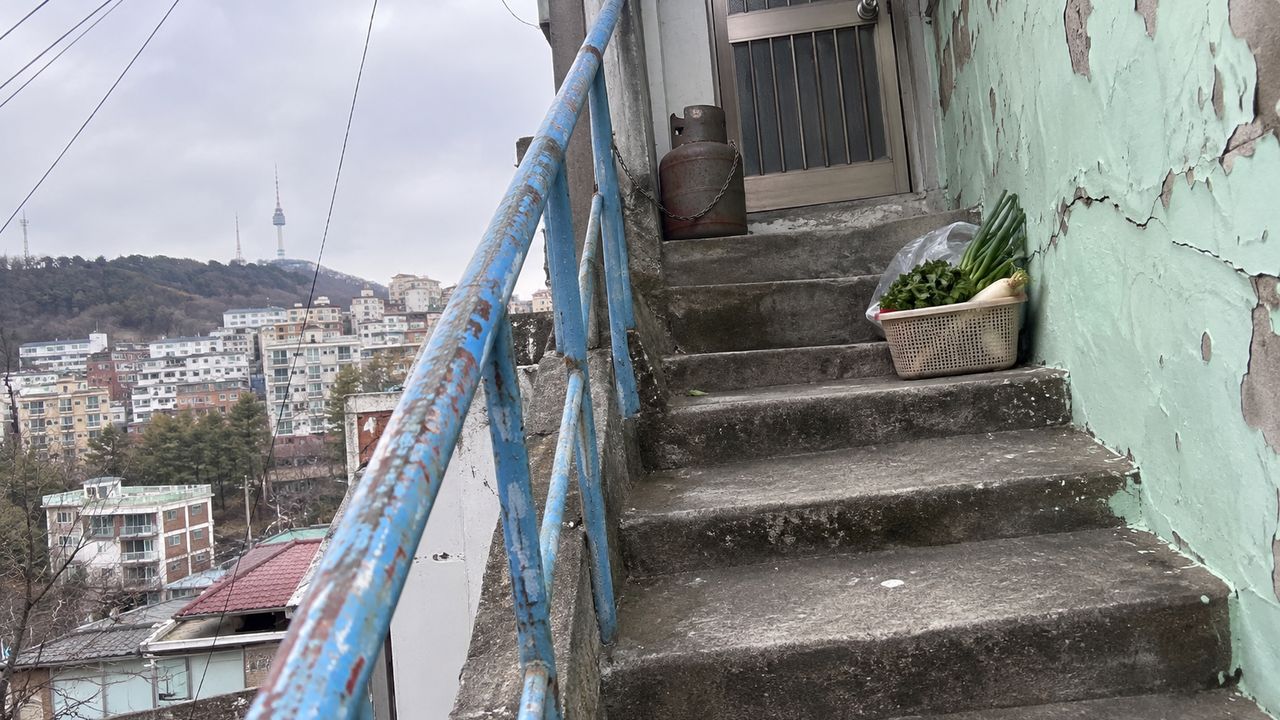
Gamcheon is a dense neighborhood of small, closely packed houses stepping down a steep hillside. The pastel walls, murals and art installations are recent additions. Visit Busan credits students, artists and residents with decorating the village as part of a Village Art Project. Korea.net credits a Ministry of Culture, Sports and Tourism project titled "Dreaming of Machu Picchu in Busan" with starting the transformation. We could not confirm three things: the exact start year, the official organizer record, and how that project relates to later alley projects.
The art was added to a working neighborhood. It did not replace one. Behind most painted walls are bedrooms, kitchens and laundry lines. Some houses have become:
- cafes
- souvenir shops
- small galleries
- rooftop viewpoints
Those are the exception. The bulk of the village is still private homes.
For maps, routes and current information, start at the village tourist information center (Haneul Maru) at the main entrance. Hours may be shorter in winter. We could not confirm them on an official page, so check current hours before you go. We also found no hours for any exhibition space. Ask there about:
- any guided tours or resident-led programs running in 2026 (we could not confirm whether any do)
- the stamp map, including whether it is still sold and what it currently costs (we could not confirm the price officially)
Guides describe the village as free to enter. We did not find an official 2026 statement either way.
The refugee history behind both neighborhoods
Gamcheon
Visit Busan says refugees settled in Gamcheon during the Korean War (1950–1953) and farmed the mountainous land to make a living. We did not find a more precise settlement period. Busan was one of the few major cities never captured during the war, and it absorbed huge numbers of refugees. Flat land was already taken. Newcomers built wherever they could, including on slopes like this one.
That history helps explain the layout:
- terraced rows of small houses
- narrow lanes
- stairways that started as self-built paths
You may read other origin stories online, including claims about specific groups settling the area. We have left those out unless they can be traced to a reliable historical source.
Ami-dong
Visit Busan's name for the area is "Ami-dong Tombstone Culture Village." Its history is harder.
- The cemetery: Visit Busan says the mountainside was a Japanese cemetery. It was neglected after liberation, when the Japanese returned home. We found no reliable founding dates.
- The housing: Refugees came to Busan and gradually turned the site into housing. Visit Busan says they built houses from planks, gravestones and stone ornaments from the graves, because building materials were scarce. Its other article ties the building to Korean War refugees. We have not quoted a number of stones or houses, because we could not find a reliable figure.
- What you can still see: Stones are still visible in some walls and stairs.
Approach this with care. The walls show how desperate the housing shortage was, and some residents or their families lived through it. Look and read the information boards. Don't pose with the stones, touch them, or treat them as a curiosity.
Getting there: bus and metro options (check 2026 routes)
The standard approach is Metro Line 1 to Toseong Station. Leave by Exit 6, then take a village bus up to Gamcheon. The routes most guides list are Saha 1-1, Seo-gu 2 and Seo-gu 2-2. These come from guidebooks and travel sites, not an official 2026 timetable. We could not confirm whether any village bus stops at Ami-dong, so check with a live map or the information center.
| Route or line | Starting point | Nearest stop to walk from | Approx. journey time | Fare basis |
|---|---|---|---|---|
| Busan Metro Line 1 | Busan Station / Nampo / Seomyeon | Toseong Station, Exit 6 | Check a live transit app | Distance-based; check the current fare with Busan Transportation Corporation |
| Village buses Saha 1-1, Seo-gu 2, Seo-gu 2-2 | Near Toseong Station | Gamcheon Culture Village stop | Check a live transit app | Check the current fare |
| Taxi | Toseong Station or Nampo-dong | Gamcheon main entrance | Check a live app | Metered. Check the current Busan taxi fare table |
From Haeundae: Take Line 2 to Seomyeon, transfer to Line 1, and ride to Toseong. Check the journey time in a transit app.
Fares and cards:
- Busan uses rechargeable transit cards. Check which card types work on the metro and village buses before you buy one. Many convenience stores sell and top up cards.
- Card fares are usually lower than cash fares, and transfers between metro and bus can be discounted. We could not verify the 2026 bus fares, transfer rules or accepted cards, so check them with Busan transit.
- Some village buses may not give change, so carry a card.
- If you plan to ride a lot in one or two days, compare a tourist pass against pay-as-you-go Check pricesKlook →Some links may be affiliate links. Disclosure.
Frequency: Village buses on this hill are small and can fill up, especially on weekends. We found no official 2026 frequency, so check a live transit app before you set off. Naver Map has an English interface. KakaoMap's English support is more limited. If you see a long queue at Toseong, a taxi split between two or three people can be worth it.
Walking the hills: what to expect
The short version is that this is a real workout.
- Lanes: Steep, often stepped, and uneven in places.
- Stairs: Some staircases are long and have no landings.
- Figures: We have not quoted an elevation gain, step count or walking times because we could not confirm them from an official source.
Choosing where to start:
- Bus to the top (most visitors): The tourist information center is at the main entrance. You will still go down into the lanes and climb back up.
- Walk up from the lower lanes (if you are fit): You do the hardest climbing while fresh. You can then finish by walking downhill toward Toseong and the markets.
Descending steep stairs is harder on knees than climbing them. Use handrails, take it slowly, and go down lanes with railings or gentler grades where you can.
Sharing narrow lanes:
- Many lanes are a single person wide, with no pavement.
- Delivery riders, carts and residents carrying shopping use these paths every day. Step aside into a gap and let them pass.
- Don't stop in the middle of a staircase for photos.
Rest and accessibility:
- Rest points include the information center area and the cafes, which are customer-only, so buy something.
- Access is limited. Stairs run through much of the village.
- We could not confirm any accessible route, ramp or lift in either village as of 2026. Wheelchair users and people with prams should ask the Saha-gu or Seo-gu office or the information center before going.
Crowd-free timing
| Time window | What to expect | Recommendation |
|---|---|---|
| Weekday, before 10:00 | Quietest. Some shops and cafes may not yet be open | Best for walking and seeing the village as it is |
| Weekday, 10:30–15:00 | Tour groups and buses concentrate here | Expect queues at popular photo points |
| Weekends and public holidays | Busy most of the day | Avoid if you can |
| After dark | Some lanes poorly lit; residents home and expecting quiet | Don't visit |
Hotspots: The main road and the most photographed spots, such as the rooftop viewpoints, crowd up first. The lanes a few turns away are often much quieter. That is also where you are closest to people's front doors, so be extra quiet there.
Public holidays that affect crowds: Seollal (Lunar New Year) and Chuseok bring more visitors. Many shops may close and families will be home. Confirm the exact holiday dates for your travel year on the official Korean public holiday calendar, because we did not re-verify them here.
Opening hours: The information center's hours may be shorter in winter, and we could not confirm them officially. We did not find hours for any official exhibition space, so check before you go.
Daylight: Sunset comes early in late autumn and winter, so plan to finish by mid-afternoon.
We found no official 2025–2026 visitor-hour rules or restrictions. Before you go, check with the Saha-gu and Seo-gu offices whether any have been introduced.
Etiquette for living neighborhoods
These are homes. The residents did not choose to live in a tourist attraction.
Keep it quiet - Talk softly, especially on stairways and near doors and windows. Sound carries in tight lanes. - Take phone calls out on the main road, not in residential alleys. - Don't play music or video aloud.
Photograph with care - Don't photograph residents, especially children and older people, without asking first. If they say no or look away, that is your answer. - Never point a camera into windows, open doors, courtyards or laundry areas. - Ask before photographing a private doorway or someone's potted garden. - Leave tripods, drones and ring lights behind. We did not verify the current drone rules, so check them with local authorities before you fly anything.
Mind the space - Don't sit on steps, walls or ledges that look private. If in doubt, assume it is. - Don't block gates, alleys or parked scooters. Step aside for anyone carrying things. - Don't open gates, climb onto rooftops that are not signed as public viewpoints, or knock on doors.
Trash and signs - Use the bins provided or carry your trash out. Leave nothing on stairs or walls. - Respect any sign asking visitors not to enter a lane, even if the lane looks photogenic.
In Ami-dong especially - Don't touch, stand on or pose with the tombstones built into walls and steps. - Read the information boards, look quietly, and move on.
Eating nearby: market food to pair with the walk
The Nampo-dong area is the natural lunch stop. It is a short metro ride, or a longer downhill trip, from Toseong. Well-known markets in the area include:
- Jagalchi Market: Seafood, including fresh fish and grilled fish restaurants. It is served by Jagalchi Station on Line 1.
- Gukje Market: A large general market with food alleys.
- Bupyeong Kkangtong Market: Known for snack stalls.
We did not verify 2026 operating days or whether any night market runs, and closing days differ by market and stall. Check before you plan lunch around a specific dish.
Typical street food: Eomuk (fish cake skewers), twigim (fried snacks), ssiat hotteok (seed-filled pancakes), bibim dangmyeon and milmyeon are all common Busan foods. We could not find a dated 2026 source for prices, so we are not quoting any. Check menu boards.
Payment: Most restaurants accept cards, but small stalls may prefer cash. Carry some small bills.
If you want to stay close to the start of this walk, the Nampo-dong and Jung-gu area puts you near Line 1 and the markets
Practical checklist and costs
Costs
| Item | Typical cost | Source to check |
|---|---|---|
| Metro fare | Not verified for 2026 | Busan Transportation Corporation |
| Village bus (card) | Not verified for 2026 | Busan city transport site / transit app |
| Taxi base fare | Not verified for 2026 | Current Busan taxi fare table |
| Village entry | Reported free, not officially confirmed | Visit Busan / Saha-gu Office |
| Stamp tour map | Price not officially confirmed; ask on arrival | Gamcheon information center |
| Ami-dong entry | Residential area; no official fee information found | Seo-gu Office |
Packing list
- Water. Shops are mostly on the main road, not in the lanes.
- Comfortable shoes with grip. Stairs can be slippery after rain.
- Sun protection in summer. A warm layer in winter, because the ridge can be windy.
- A topped-up transit card.
- Small bills for stalls.
- A small bag for your own trash.
- Mobile data, so maps and bus arrivals load on the hill Check pricesAiralo eSIM →Some links may be affiliate links. Disclosure.
Before you leave, confirm:
- village bus routes and the Toseong Station exit
- information center hours, especially in winter
- market closing days
- any new visitor rules for 2026
The short version: go early, walk slowly, keep quiet, and remember that the people living behind the painted walls are the reason these neighborhoods exist.
FAQ
How do I get to Gamcheon Culture Village from Busan Station?
Take Busan Metro Line 1 to Toseong Station and leave by Exit 6, then ride a village bus up to Gamcheon. Village bus routes Saha 1-1, Seo-gu 2 and Seo-gu 2-2 are commonly listed in guides, but confirm current 2026 routes and fares on a live transit app or with Busan transit before you go.
What is the best time to visit Gamcheon and Ami-dong?
A weekday morning, arriving before 10:00, is the quietest time. Weekends and public holidays are busy, and after dark the lanes are poorly lit and residents are home. Plan to finish by mid-afternoon, especially in winter.
Is Gamcheon free to enter?
Guides describe it as free to enter, but we did not find an official 2026 statement confirming this. Check with the Gamcheon information center or the Saha-gu Office before your visit.